Stations Part 2, Lunar Orbit

Vimeo: https://vimeo.com/309137882

YouTube: https://youtu.be/YZj6RmCgXJ8

Welcome to Kerbalism! I’m your host Aubrey Goodman. In this episode, we deploy orbital stations to our moons.

In our quest to explore our solar system, we seek new information to help us make sense of the universe, to expand our understanding of physics. Having a manned station in orbit around a moon helps pave the way toward increased traffic to the moon and acts as a support point for missions to its surface.

Just as we did for planetary stations, we first send an unmanned fuel pod into low lunar orbit. This will help prepare for future missions. Deploying a manned science station at the same altitude but on the opposite side of the orbit helps increase utility. The fuel pod acts as a last ditch option for crafts running critically low on fuel. Having both stations on the same orbit at opposite ends effectively doubles the chance a struggling craft can dock with a station.

Orbital science stations act as a staging point for science missions to the surface. We want to make sure we have docking ports of all sizes on these stations, again to maximize utility. Also, since this station will be supporting other smaller craft, it needs a large cache of fuel, monopropellant, and electricity.

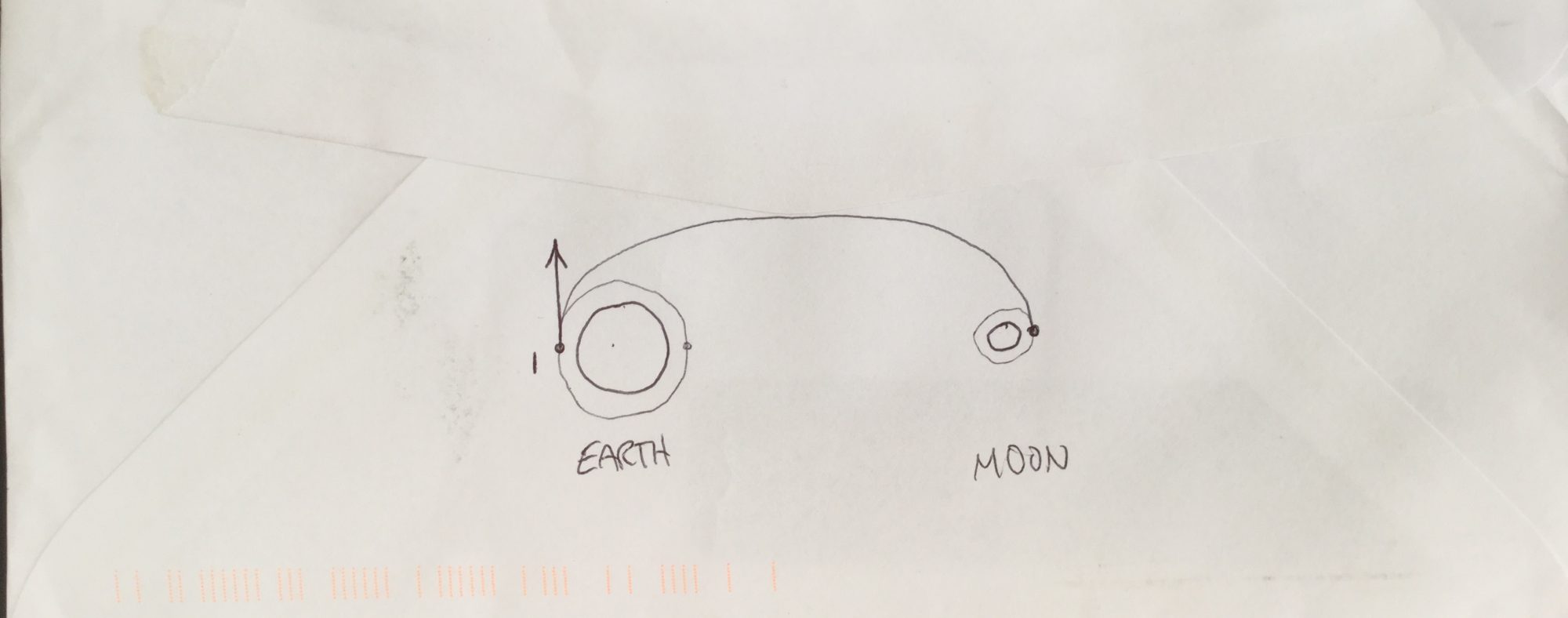
After the station is assembled in planetary orbit, with all its supporting craft docked, we’re ready for transfer orbit. With fuel reserves adequately filled, we plan and execute our lunar transfer maneuvers. This means a prograde maneuver from planetary orbit and a retrograde maneuver to settle into a low circular orbit around the moon.

From here, we can send our unmanned support craft to the surface to explore and gather samples. We can also ferry tourists to the surface for a space selfie. Tourism helps generate revenue to stoke the financial furnace to pay for our science missions.

We’ve spent a considerable amount of resources just to deploy stations to our moons. It’s going to take a lot more funding to build and deploy manned stations to other planets. In our next episode, we send a manned station to Duna, which is a lot like Mars. Don’t miss it!

And thanks for watching Kerbalism!
Satellites Part 3: Deploying to Solar Orbit

Vimeo: https://vimeo.com/308309765

YouTube: https://youtu.be/xpVvTuxP1XA

Welcome to Kerbalism! I’m your host, Aubrey Goodman. In this episode, we deploy two relays to solar orbit to become the backbone of our solar system communications relay network.

Before we can expand our horizons to visit other planets in the solar system, we need to have some infrastructure. Satellites sent to moons only need to communicate back to their planetary base. If we sent a satellite to another planet, we would need to make sure it has a very powerful radio to reach our home base. Also, as planets move around the solar system, the distance between them changes. In some situations, planets might find themselves on opposite sides of the star.

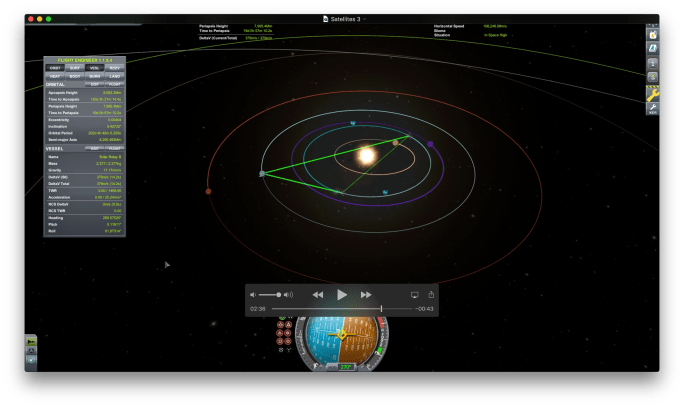
If we introduce a relay network in solar orbit, we can support a wider range of missions. Kerbin orbits around its star at 13.6 million kilometers. By placing a pair of relays in solar orbit at 8 million kilometers, the relays themselves are never more than 16 million kilometers apart, nor more than 16 million kilometers from Kerbin. This way, anything within range of a relay will be able to communicate with home base.

For orbital missions, such as placing satellites in orbit of other planets in the system, having a solar relay network is vital to maintaining connection with your probes. This will reduce payload antenna requirements and thus reduce costs, enabling more missions over time.

Observant viewers will note the two-node approach suffers the problem of having the star directly in the line-of-sight path between the relays. Using a three-node approach would eliminate the line-of-sight problem, at the cost of one extra relay. Also, positioning the relay itself is a very slow process, and making adjustments along the way would use too much fuel. Like so many things in space, it’s important to get it right the first time.

In this case, we settle for having two relays in circular solar orbits, and not quite exactly opposite each other. This gives us coverage for missions to all inner planets. The natural evolution of our relay network is to send smaller relays to each planet. This enables reduced cost missions with smaller radio equipment. If the probe only needs to communicate with the nearest relay network node, we can use the same equipment we used for lunar satellites.

So that’s all for relays. Now that we have the basis of our relay network, we can begin to discover more things about our solar system. One way we do that is by building stations in orbit. So, in our next episode, we’ll discuss orbital stations around our planet. Stay tuned!

And thanks for watching Kerbalism!

Satellites Part 2: Lunar Orbit

Vimeo: https://vimeo.com/307753956

YouTube: https://youtu.be/qCvHz1n0qxU

Welcome to Kerbalism. I’m your host, Aubrey Goodman. In this episode, we’ll review the deployment of satellites to lunar orbit.

First, let’s expand to consider the nearest moon. It requires more deltaV to get there, and more still to stabilize in a circular orbit. The good news is our Kerbin orbital satellite is over designed for its task. Its first stage does almost all the work, and we have plenty of fuel left over in the second stage for transfer orbit burns.

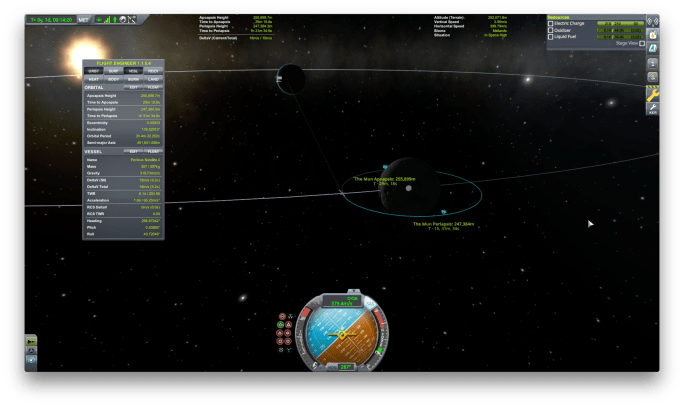
Once the craft is in planetary orbit, we need to perform two maneuvers to stabilize into orbit around Mun. If we do a really good job executing the maneuvers, we will settle into a circular orbit.

Orbital transfer between Kerbin and Mun can be done really at any time from a mostly equatorial orbit. This refers to the inclination of the orbital plane relative to the rotation of the body. Kerbin and Mun have very similar inclination, making it convenient to transfer between them. As we’ll find later, Kerbin’s other moon, Minmus, has a different inclination.

While a transfer can be made between Kerbin and Mun at any time, there are optimal points along the orbit where fuel use can be minimized, due to favorable alignment. Sometimes, we can save a huge amount of fuel simply by waiting for 20-30 mins.

Once we find a transfer orbit we like, with a destination periapsis at the desired altitude – that means the periapsis of the resulting orbit around Mun – once we find that periapsis, we can proceed with executing the maneuver at the appropriate time. Even perfect execution will result in slight misalignment with your designed objective. This is expected. If necessary, you can make corrections with RCS, but this is generally not required.

Now, after some time has passed your craft has traversed its path and is now approaching the periapsis of the destination orbit. You must burn retrograde until you slow down enough to stabilize into an elliptical orbit. Then, bring the apoapsis down to around the same altitude as the periapsis, resulting in a circular orbit.

Kerbin has a second moon, called Minmus. Its orbital inclination is about 6 degrees higher than Kerbin, so any craft headed there must also perform a maneuver to align its inclination. This is ideally done during orbital ascent, which reduces the inclination difference.

Our over designed satellite has enough fuel to enter stable orbits of both moons. But it also does very little. As we add capability to our satellite, the payload mass increases, and the first stage fuel requirements increase exponentially.

So that’s it for lunar satellites. In the next episode, we’ll focus on solar satellites; that is, satellites on an orbit similar to a planet. Those will lead us to a place where we will be able to establish a relay network of satellites that allows us to explore a wider part of the solar system. So stay tuned for that and much more!

And thanks for watching Kerbalism!

Satellites, Part 1: Deploying to Low Orbit

Vimeo: https://vimeo.com/307509709

YouTube: https://youtu.be/ZcPy605hAiM

Welcome to Kerbalism! I’m your host, Aubrey Goodman. In this episode, we’ll review the basics of deploying a satellite to low orbit. Let’s get started!

Long before we think about sending people into orbit, we need to send smaller unmanned probes. These serve as opportunities to learn about the perilous environment of low orbit. As we’ll show, they also present a solution to the issue of communication within the solar system. Without relays to boost the signal back to the origin planet, probes must carry heavy radio hardware powerful enough to reach home. Heavy things cost more to send to orbit. Lowering the cost is often a matter of reducing payload mass or using fuel more efficiently. There are many things to consider, even when designing a simple satellite deployment mission.

First, let’s look at the simplest case, deploying to planetary orbit. Here, we use Kerbin as our planet. It is similar to Earth, so it works very well as a learning and planning tool.

The simplest form of an orbital launch vehicle is a single stage configuration. This means the entire vehicle is one single unit ready to fly to orbit, from takeoff through ascent to low orbit. This is both inefficient and expensive for a satellite. There’s really no reason for the heavy lift stage to remain in orbit once the satellite has reached its intended orbit.

Rather than hauling heavy engines and fuel tanks into orbit to live forever awkwardly attached to our satellite, we will consider a more popular two stage configuration. In this case, we use a solid rocket first stage and a liquid second stage for orbital stabilization and precision maneuvering.

Using a solid rocket first stage has some side effects. The most important is they burn until the fuel is gone. There is no in-flight throttle control. Throttle can be achieved by narrowing the nozzle geometry, but this is a design-time decision and significantly impacts the construction cost.

Using a liquid first stage, we would be able to cut throttle on the ascent, and throttle back up at the peak of ascent to circularize the orbit for payload deployment. Then, if we’ve done well, we can burn retrograde to return the first stage back to the surface.