Mining Part 2, Mining Colony

Vimeo: https://vimeo.com/324381843

YouTube: https://youtu.be/1MprhkvcIaw

Welcome to Kerbalism! I’m your host, Aubrey Goodman. In this episode, we upgrade a manned surface station into a mining colony.

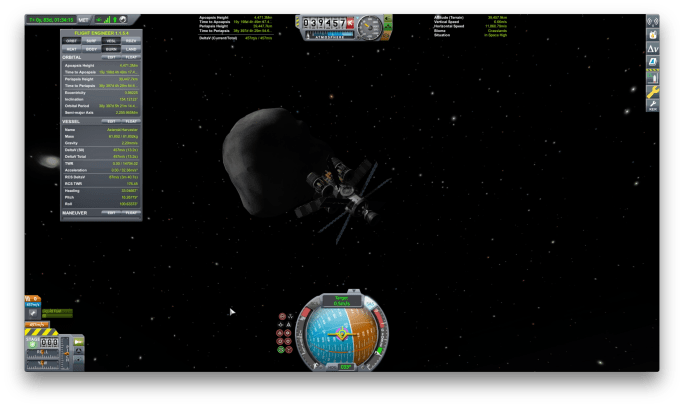
In our last episode, we landed a construction core on Minmus, ready to expand itself to support higher volume resource processing. Now, it’s time to grow our station into our first mining colony. We need a manned presence to enable ongoing mining operations, extracting resources from the surface.

With asteroids, there is a much smaller opportunity for resources. If the asteroid is only one thousand tons, we spend a lot of energy and time with finite benefit, equal to the mass of the asteroid. We must repeat this for each asteroid we wish to harvest. If the asteroids are small, we may use more resources capturing them than they yield from processing.

Moons are different. Resource abundance on the moon surface is effectively limitless, compared to the cache in the asteroid. Once we’re settled in at a good location, we can produce an arbitrary amount of fuel and send it back to orbit. We’ve chosen Minmus because its surface-to-orbit delta-v is very small. The cost of sending resources from the surface to orbit is much lower than Mun or Kerbin. From the surface of Minmus, we can launch into low planetary orbit for about one third the cost of launching from the planet directly.

The construction core is designed for expansion. The goal is to land the bare minimum mining gear and use it to build the rest on-site. Our station core has both radial and vertical expansion options. After we add processing components, we expand outward with more support struts with the same radial and vertical options. These become new expansion points and we repeat as needed.

Of course, expansion comes with its own challenges. Our first expansion of processing equipment was lost when it overheated and exploded. Fortunately, no other nearby parts were damaged. The expansion plan must include increased solar and thermal management. We also need to leave room for ships to land for refueling. These vessels will not be docking in the traditional sense. They simply land near the station and connect via fuel hose. The hoses are limited in length, so ships will need to land close to the hub and wait for colony crew to attach the hose before fuel transfer can begin. Once attached, the station can transfer stored fuel or make new fuel on-demand, until the ship’s reserves are full. Then, it’s simply a matter of detaching the fuel hose and blasting off to Minmus orbit to rendezvous with an orbital fuel station.

Using this technique, we can deliver fuel within our planetary system to support the needs of any ships traveling between the planet and its moons. As we expand to other planets, we create new mining colonies on moons as needed.

As always, thanks for watching Kerbalism!

Asteroids Part 3, Orbital Fuel Infrastructure

Vimeo: https://vimeo.com/313035570

YouTube: https://youtu.be/s0joNt7b0D8

Welcome to Kerbalism! I’m your host, Aubrey Goodman. In this episode, we build our first ship in space using resources collected from asteroids.

Building things in space isn’t much different from building on the planet’s surface. The laws of physics are the same, and delta-v calculations rely purely on thrust, mass, and fuel. The main reason we build in space instead of on the planet is the cost of sending things into orbit. Every craft we build must use a minimum delta-v to launch into orbit. This means we need exponentially larger launch vehicles for larger payloads. If we build in orbit, we only need to build the payload.

This means our spacecraft designs can now focus on optimizing for mission requirements. It also means we are no longer constrained by the aerodynamic environment. With the exception of atmospheric surface landers or gas giant surveyors, our designs need not take drag forces into consideration, since they will always be in space.

First, let’s look at one of our most important vehicles – the ore tug. This craft will ferry ore between the asteroid harvester and an orbital construction platform. It will need enough fuel reserves to perform the transfer orbital maneuvers required to move between the harvester and construction platform. It needs to account for a full ore storage tank in one direction and an empty tank in the other. This way, we don’t over design and bring more fuel than we need.

Next, let’s consider the construction platform itself. The platform is assembled in space, just like the other stations. We launch various components in phases, starting with a core and adding empty storage containers and fuel tanks. Since we will be building things using raw materials, we will need containers for those materials. The size of our containers will be the limiting factor preventing us from building beyond a maximum mass. We need the materials on-hand to build our craft.

With our fully operational station, we can begin to ferry ore from the asteroid. Here, we use some KSP addons to approximate the logistics of manufacturing. Ore is processed into metal and fuel. Metal is subsequently processed into rocket parts, which we use to assemble our spacecraft.

After we have processed and prepared our resources, we begin construction of our first spacecraft. We’re going to build onto our existing station first to expand its existing capabilities before we start building other things as well. Then we’ll build a construction core, with all the capabilities of our orbital platform.

In our next episode, we land our construction core on Minmus and use it to begin building other components.

Thanks for watching Kerbalism!

Asteroids Part 2, Capture and Harvest

Vimeo: https://vimeo.com/311723008

YouTube: https://youtu.be/628eqhhpV5s

Welcome to Kerbalism! I’m your host, Aubrey Goodman. In this episode, we harvest resources from an asteroid and use them to capture the asteroid in orbit.

In our last episode, we intercepted an asteroid and grabbed onto it. We still need to slow it down in order to capture it into planetary orbit. If we don’t slow down, our harvester will be swept out of the planet’s sphere of influence to solar orbit along with the asteroid. Since the whole point is to use the resources within the asteroid, we need a retrograde burn with the asteroid in tow.

We’ve used most of the fuel to position our harvester. If we’re lucky, we might have some fuel to slow down, but there’s a good chance we’ll need to do a little harvesting before we can perform the maneuver.

This is where we begin to encounter the boundaries of what KSP can do. As sophisticated as it is, the unmodified game supports only one form of resource processing – fuel. We can convert ore into various fuels, but we can’t make metal or rocket parts to build directly in space. There are addons to enable this, and we’ll use them in the next episode.

This is also where we surpass the real world capability. The game allows players to grapple an asteroid and extend drills, all with the click of a button. Clearly, we don’t yet have this level of technology available in the real world.

The reason we use a harvester to capture our asteroid is simple. It would be expensive to bring enough fuel to slow down the asteroid, so we bring harvesting equipment along and use it to make fuel after we arrive. By carrying fuel processing components, we can plan to use most of our fuel to intercept and attach to the asteroid. Then, we can mine resources and process them into fuel to fill our tanks before the return trip.

With adequate fuel in our tanks, we perform a retrograde maneuver to settle into stable planetary orbit. The final altitude of our asteroid’s orbit will affect our orbital fuel harvesting operations, so it’s important to consider the details.

If the asteroid inclination is high, we will need extra fuel to ferry ore between the harvester and the processing facility. However, the asteroid itself is massive, so we would need a lot of fuel to move it to a different orbit. In our example, we settle into a circular orbit around the planet, between our two moons, but in a highly inclined orbit.

With an asteroid in stable orbit around the planet, we can begin to use its resources. In our next episode, we refine these resources into metal and rocket parts to build spacecraft directly in orbit. Don’t miss it!

And thanks for watching Kerbalism!

Asteroid Part 1, Intercept and Rendezvous

Vimeo: https://vimeo.com/309555177

YouTube: https://youtu.be/0g4-8K4fRVg

Welcome to Kerbalism! I’m your host, Aubrey Goodman. In this episode, we intercept and rendezvous with an asteroid.

As we expand to build stations on other planets in the system, we need to evolve our concept of manufacturing. Instead of building everything on Kerbin and launching to orbit, it makes more sense to build an orbital construction facility and use resources collected from asteroids to build new craft directly in orbit.

Before we can do anything with an asteroid, we need to identify and classify nearby objects worthy of our attention. This is the first part of a sequence of tasks we must undertake in order to collect materials from an asteroid and refine them. A tiny asteroid may have only 15 tons of usable resource material. While it may sound like a lot to the uninitiated, this would yield barely enough fuel to a few maneuvers.

In order to find high value targets, we need a solar satellite with an infrared scanner. With this equipment, we can identify and begin to evaluate possible targets. This new satellite is smaller than our solar relay. It uses less fuel to deploy. We will eventually need more than one, so we can identify asteroids at different distances from the star.

Using our infrared scanner, we begin to identify nearby asteroids. In KSP, there are alerts notifying the player about newly discovered objects. We need to find one on an intercept course with Kerbin. This makes it easier to get to the asteroid. Objects further away or not already on an intercept course will require more fuel and more advanced planning to capture into orbit. The asteroid itself is traveling faster than the planet, so it will not settle into orbit around the planet on its own. We must grab it and slow it down to stabilize in orbit.

In this example, we’ve settled on a target asteroid about 50 tons in mass. Its existing intercept orbit will bring it within 39 thousand kilometers of the planet. This means we need about the same delta-v as a trip to Minmus. Again, we would need much more to intercept with a free asteroid on a solar orbit.

Just as we saw with orbital stations, asteroid harvesters must also be assembled in orbit over several phases. For the purposes of this episode, we will build it on Kerbin and send it into orbit empty. Then, we send support missions to deliver fuel to the harvester in orbit. It would be prohibitively expensive to send the fully fueled harvester into orbit. All that fuel weighs a lot, requiring more powerful engines, which weigh even more. By reducing the payload mass by delivering components in parts, we can dramatically reduce the first stage fuel requirements.

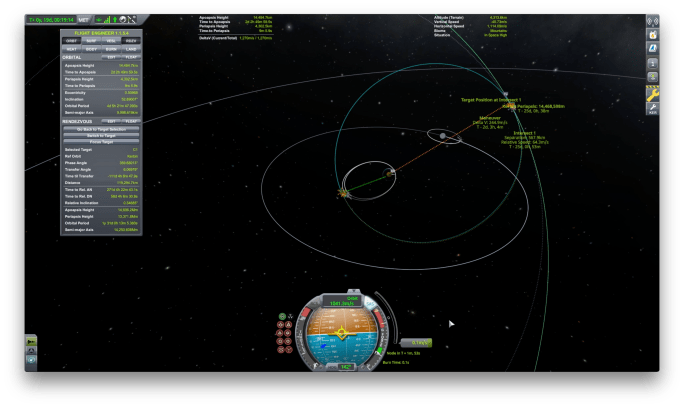
Once we have the harvester fueled up and ready to go, we can proceed with the rendezvous. We do this in four maneuvers.

First, we need to align the harvester’s orbital plane with the asteroid. For highly inclined orbits, this may use a lot of fuel. One of the benefits of being in low planetary orbit is easy access to refuel missions. If you use a lot of fuel changing the inclination, you can top up the tanks before the long trip out to the rendezvous point.

Second, we need a prograde burn to raise the harvester’s apoapsis to match the asteroid’s periapsis. In other words, we raise the high point of the harvester orbit until it meets the low point of the the asteroid orbit.

Third, we need another prograde burn to bring the harvester periapsis up to a point where the two craft come within 50km of each other near the rendezvous point. This is a precision maneuver and requires a bit of finesse to pull it off.

Finally, we burn in the direction of the target to close the gap, ultimately locking onto the asteroid with the grappler. After we have our asteroid locked, we point the solar panels toward the star. Then we can start drilling!

Intercepting an asteroid requires a lot of delta-v. There’s a good chance we used up most of our fuel in the intercept process. Now it’s time to get ready for our next episode, capturing the asteroid down to planetary orbit. We will need to collect ore and process it into more fuel to slow down the asteroid. Stay tuned!

And thanks for watching Kerbalism!

Stations Part 3, Nearby Planets

Vimeo: https://vimeo.com/310704564

YouTube: https://youtu.be/V6dT4-zPk8c

Welcome to Kerbalism! I’m your host, Aubrey Goodman. In this episode, we send a manned station to Duna.

After we have built sufficient infrastructure, we’re ready to take a bold step. It’s time to send a manned mission to orbit around another planet in our solar system. In the real world, we would be going to Mars. For the purposes of our discussion, we’ll go to Duna, which is a lot like Mars.

Just as before, we will construct our station in planetary orbit before sending it on its way. This time, though, we need to use completely different designs for the support craft we’ll be taking with us. The science and tourism landers designed in the last episode were meant for landings on moons.

Duna has significantly more mass than a moon. Its gravity is about twice that of the Moon, so we need extra delta-v to land safely. We do get one huge benefit for free. By landing somewhere with an atmosphere, we can use heat shields and parachutes to slow our descent. This saves a lot of delta-v and reduces the fuel requirements for our landers.

Science landers involving samples will need a reserve of fuel to takeoff and return to the station. For now, we will skip the return trip to save on weight. Until we have a more sophisticated refueling option, fuel is a precious resource. We’re also sending relay satellites instead of tourism landers. Ferrying tourists will have to wait. Besides, the landers are no good if they can’t communicate their findings back to home base.

With our station assembled and all its support craft docked, we’re ready to plan an escape orbit! We could simply burn prograde to accelerate out of Kerbin’s gravity, but this would need a lot of fuel. Instead, we rely on the moon to give us a gravity assist. By flying close to the moon’s surface, we take advantage of the moon’s gravity to accelerate us away from the planet.

It works like this. If we encounter the moon on the leading side, in its direct path, its gravity will slow us down. If we find ourselves on the trailing side, in its wake, we will slingshot around it and gain enough speed to escape planetary orbit.

Now that we’re on a solar orbit, outside of Kerbin’s gravitational influence, we can chart a course to Duna. Unfortunately for us, we have chosen our launch timing poorly. We must wait nearly 400 days before our Duna intercept. Clearly, we’ve glossed over the details about planning to sustain a crew for 2yrs until the next resupply mission can be expected to arrive. In the real world, people need to eat.

As we approach the planetary encounter, the station prepares to perform a retrograde burn to settle into a circular orbit. After assessing our fuel status, we determine we have sufficient fuel to deploy our relays before descending into our final orbit to deploy surface landers.

Now that we have stations spreading throughout the system, we need a sustainable way to harvest fuel in space. After watching time lapse video of refueling missions, maybe you’ve started to appreciate the value of finding fuel sources in deep space. In our next episode, we intercept an asteroid and begin to harvest its resources!

And thanks for watching Kerbalism!

Stations Part 2, Lunar Orbit

Vimeo: https://vimeo.com/309137882

YouTube: https://youtu.be/YZj6RmCgXJ8

Welcome to Kerbalism! I’m your host Aubrey Goodman. In this episode, we deploy orbital stations to our moons.

In our quest to explore our solar system, we seek new information to help us make sense of the universe, to expand our understanding of physics. Having a manned station in orbit around a moon helps pave the way toward increased traffic to the moon and acts as a support point for missions to its surface.

Just as we did for planetary stations, we first send an unmanned fuel pod into low lunar orbit. This will help prepare for future missions. Deploying a manned science station at the same altitude but on the opposite side of the orbit helps increase utility. The fuel pod acts as a last ditch option for crafts running critically low on fuel. Having both stations on the same orbit at opposite ends effectively doubles the chance a struggling craft can dock with a station.

Orbital science stations act as a staging point for science missions to the surface. We want to make sure we have docking ports of all sizes on these stations, again to maximize utility. Also, since this station will be supporting other smaller craft, it needs a large cache of fuel, monopropellant, and electricity.

After the station is assembled in planetary orbit, with all its supporting craft docked, we’re ready for transfer orbit. With fuel reserves adequately filled, we plan and execute our lunar transfer maneuvers. This means a prograde maneuver from planetary orbit and a retrograde maneuver to settle into a low circular orbit around the moon.

From here, we can send our unmanned support craft to the surface to explore and gather samples. We can also ferry tourists to the surface for a space selfie. Tourism helps generate revenue to stoke the financial furnace to pay for our science missions.

We’ve spent a considerable amount of resources just to deploy stations to our moons. It’s going to take a lot more funding to build and deploy manned stations to other planets. In our next episode, we send a manned station to Duna, which is a lot like Mars. Don’t miss it!

And thanks for watching Kerbalism!

Stations Part 1: Planetary Orbit

Vimeo: https://vimeo.com/308821250
YouTube: https://youtu.be/gIWuT522JG4

Welcome to Kerbalism! I’m your host, Aubrey Goodman. In this episode, we deploy a station to planetary orbit.

So far, we’ve only sent small things into space. Now, we’ll start to experiment with larger objects. The best place to start is a station in low planetary orbit. As you may have noticed by now, this will be pretty much the beginning of any mission. The first step will often be stable low orbit. From there, we have options.

One of the most important components of a successful spacefaring society is a system of orbital fuel depots. These unmanned stations act as storage containers for extra fuel. We will use them for future missions, where it makes sense to refuel in space after launch before continuing on a mission.

This technique will be the foundation for all advanced missions. By staging fuel and other components at key locations, future missions can take advantage of pre-staged resources. The goal is to deploy sufficient equipment to extract and refine the natural resources available in space and on the surface of other orbital bodies. But that’s a lot of work!

We’ll start with a simple orbital fuel pod. This needs to have docking ports, some kind of attitude control system, and enough solar panels to keep it powered. Ships docking with this fuel depot may need to top off various different fuels, so keeping a little of everything on hand is helpful. Our example shows only monopropellant and liquid fuel storage.

A fuel pod is a great start, but we need to start sending manned missions now that we have infrastructure in place. This means we’re ready to send science missions! By launching scientists into orbit, we begin to explore the effects of zero gravity on materials and living tissue. This can be a great accelerator, pushing the cutting edge of our technology ever faster.

Still, just as in real estate on terra firma, location is key. There’s only so much to be learned in low orbit. In our next episode, we expand to consider stations in lunar orbit around a moon. So stay tuned!

And thanks for watching Kerbalism!

Satellites Part 3: Deploying to Solar Orbit

Vimeo: https://vimeo.com/308309765

YouTube: https://youtu.be/xpVvTuxP1XA

Welcome to Kerbalism! I’m your host, Aubrey Goodman. In this episode, we deploy two relays to solar orbit to become the backbone of our solar system communications relay network.

Before we can expand our horizons to visit other planets in the solar system, we need to have some infrastructure. Satellites sent to moons only need to communicate back to their planetary base. If we sent a satellite to another planet, we would need to make sure it has a very powerful radio to reach our home base. Also, as planets move around the solar system, the distance between them changes. In some situations, planets might find themselves on opposite sides of the star.

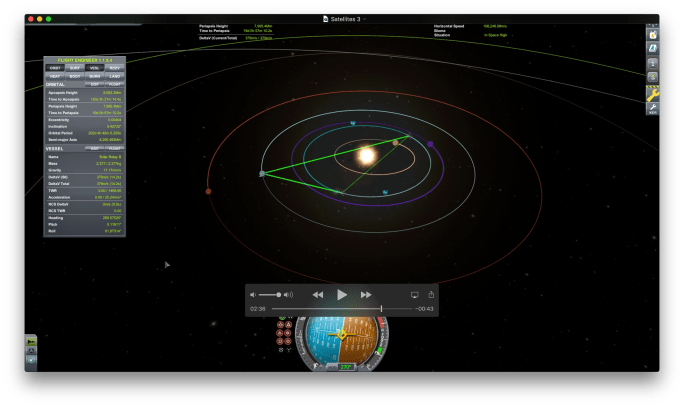
If we introduce a relay network in solar orbit, we can support a wider range of missions. Kerbin orbits around its star at 13.6 million kilometers. By placing a pair of relays in solar orbit at 8 million kilometers, the relays themselves are never more than 16 million kilometers apart, nor more than 16 million kilometers from Kerbin. This way, anything within range of a relay will be able to communicate with home base.

For orbital missions, such as placing satellites in orbit of other planets in the system, having a solar relay network is vital to maintaining connection with your probes. This will reduce payload antenna requirements and thus reduce costs, enabling more missions over time.

Observant viewers will note the two-node approach suffers the problem of having the star directly in the line-of-sight path between the relays. Using a three-node approach would eliminate the line-of-sight problem, at the cost of one extra relay. Also, positioning the relay itself is a very slow process, and making adjustments along the way would use too much fuel. Like so many things in space, it’s important to get it right the first time.

In this case, we settle for having two relays in circular solar orbits, and not quite exactly opposite each other. This gives us coverage for missions to all inner planets. The natural evolution of our relay network is to send smaller relays to each planet. This enables reduced cost missions with smaller radio equipment. If the probe only needs to communicate with the nearest relay network node, we can use the same equipment we used for lunar satellites.

So that’s all for relays. Now that we have the basis of our relay network, we can begin to discover more things about our solar system. One way we do that is by building stations in orbit. So, in our next episode, we’ll discuss orbital stations around our planet. Stay tuned!

And thanks for watching Kerbalism!

Satellites Part 2: Lunar Orbit

Vimeo: https://vimeo.com/307753956

YouTube: https://youtu.be/qCvHz1n0qxU

Welcome to Kerbalism. I’m your host, Aubrey Goodman. In this episode, we’ll review the deployment of satellites to lunar orbit.

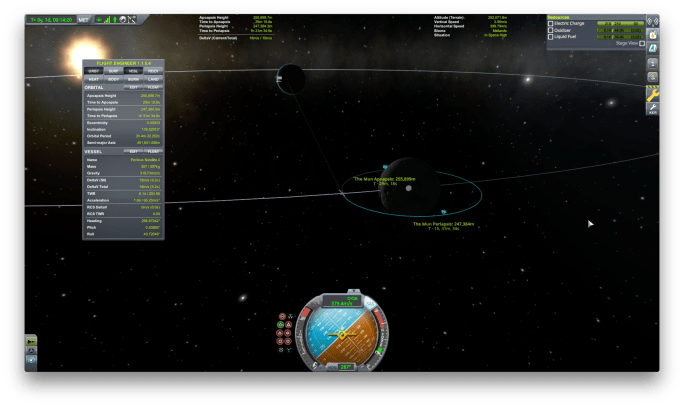
First, let’s expand to consider the nearest moon. It requires more deltaV to get there, and more still to stabilize in a circular orbit. The good news is our Kerbin orbital satellite is over designed for its task. Its first stage does almost all the work, and we have plenty of fuel left over in the second stage for transfer orbit burns.

Once the craft is in planetary orbit, we need to perform two maneuvers to stabilize into orbit around Mun. If we do a really good job executing the maneuvers, we will settle into a circular orbit.

Orbital transfer between Kerbin and Mun can be done really at any time from a mostly equatorial orbit. This refers to the inclination of the orbital plane relative to the rotation of the body. Kerbin and Mun have very similar inclination, making it convenient to transfer between them. As we’ll find later, Kerbin’s other moon, Minmus, has a different inclination.

While a transfer can be made between Kerbin and Mun at any time, there are optimal points along the orbit where fuel use can be minimized, due to favorable alignment. Sometimes, we can save a huge amount of fuel simply by waiting for 20-30 mins.

Once we find a transfer orbit we like, with a destination periapsis at the desired altitude – that means the periapsis of the resulting orbit around Mun – once we find that periapsis, we can proceed with executing the maneuver at the appropriate time. Even perfect execution will result in slight misalignment with your designed objective. This is expected. If necessary, you can make corrections with RCS, but this is generally not required.

Now, after some time has passed your craft has traversed its path and is now approaching the periapsis of the destination orbit. You must burn retrograde until you slow down enough to stabilize into an elliptical orbit. Then, bring the apoapsis down to around the same altitude as the periapsis, resulting in a circular orbit.

Kerbin has a second moon, called Minmus. Its orbital inclination is about 6 degrees higher than Kerbin, so any craft headed there must also perform a maneuver to align its inclination. This is ideally done during orbital ascent, which reduces the inclination difference.

Our over designed satellite has enough fuel to enter stable orbits of both moons. But it also does very little. As we add capability to our satellite, the payload mass increases, and the first stage fuel requirements increase exponentially.

So that’s it for lunar satellites. In the next episode, we’ll focus on solar satellites; that is, satellites on an orbit similar to a planet. Those will lead us to a place where we will be able to establish a relay network of satellites that allows us to explore a wider part of the solar system. So stay tuned for that and much more!

And thanks for watching Kerbalism!

Satellites, Part 1: Deploying to Low Orbit

Vimeo: https://vimeo.com/307509709

YouTube: https://youtu.be/ZcPy605hAiM

Welcome to Kerbalism! I’m your host, Aubrey Goodman. In this episode, we’ll review the basics of deploying a satellite to low orbit. Let’s get started!

Long before we think about sending people into orbit, we need to send smaller unmanned probes. These serve as opportunities to learn about the perilous environment of low orbit. As we’ll show, they also present a solution to the issue of communication within the solar system. Without relays to boost the signal back to the origin planet, probes must carry heavy radio hardware powerful enough to reach home. Heavy things cost more to send to orbit. Lowering the cost is often a matter of reducing payload mass or using fuel more efficiently. There are many things to consider, even when designing a simple satellite deployment mission.

First, let’s look at the simplest case, deploying to planetary orbit. Here, we use Kerbin as our planet. It is similar to Earth, so it works very well as a learning and planning tool.

The simplest form of an orbital launch vehicle is a single stage configuration. This means the entire vehicle is one single unit ready to fly to orbit, from takeoff through ascent to low orbit. This is both inefficient and expensive for a satellite. There’s really no reason for the heavy lift stage to remain in orbit once the satellite has reached its intended orbit.

Rather than hauling heavy engines and fuel tanks into orbit to live forever awkwardly attached to our satellite, we will consider a more popular two stage configuration. In this case, we use a solid rocket first stage and a liquid second stage for orbital stabilization and precision maneuvering.

Using a solid rocket first stage has some side effects. The most important is they burn until the fuel is gone. There is no in-flight throttle control. Throttle can be achieved by narrowing the nozzle geometry, but this is a design-time decision and significantly impacts the construction cost.

Using a liquid first stage, we would be able to cut throttle on the ascent, and throttle back up at the peak of ascent to circularize the orbit for payload deployment. Then, if we’ve done well, we can burn retrograde to return the first stage back to the surface.