
Vimeo: https://vimeo.com/305384440
YouTube: https://www.youtube.com/watch?v=wMqwyPoBY5k
Space is dark, lonely, and cold… most of the time. Rockets are dangerous; sometimes they explode. Atmospheric re-entry is violent. Sometimes parachutes don’t deploy. In short, space is hard.
From the very first rocket tests in the 1930s, rocketry has been a dangerous field. Early rocket tests had no passengers of any kind. We didn’t want to risk sending humans into the unknown.
After the early rocket tests started to stabilize and launches were starting to succeed more frequently, we expanded to biological payload. Yes, we sent a monkey into space. While we may want to believe he looked like an astronaut in a space suit, in reality it was different. The world saw it on the cover of Life magazine in 1961.
Once we proved we could keep a monkey alive, we started sending manned missions. Over the years, many brave men and women gave their lives so we could learn how to protect living passengers. The stakes are very high, and even the smallest mistakes can lead to catastrophe. Make no mistake, this is a high risk high reward scenario.
We continue in the face of adversity because the benefits are nearly limitless. The cultural and scientific value of visiting other planets is hard to imagine, let alone calculate.
You can read about all the heroes, tragedies, and triumphs in history books. You can also read textbooks about orbital mechanics. But how do we make it easily accessible to everyone? With games! Video games rely on simulated environments to represent the physical world with stunning accuracy.
We can use tools like Kerbal Space Program (KSP) to learn more about space in a fun and emotionally compelling way. It empowers intrepid explorers to design, build, and fly rockets and experience the challenges of space flight in a hyper-realistic way. Before we get into the details, let’s start with something we can sketch on paper.
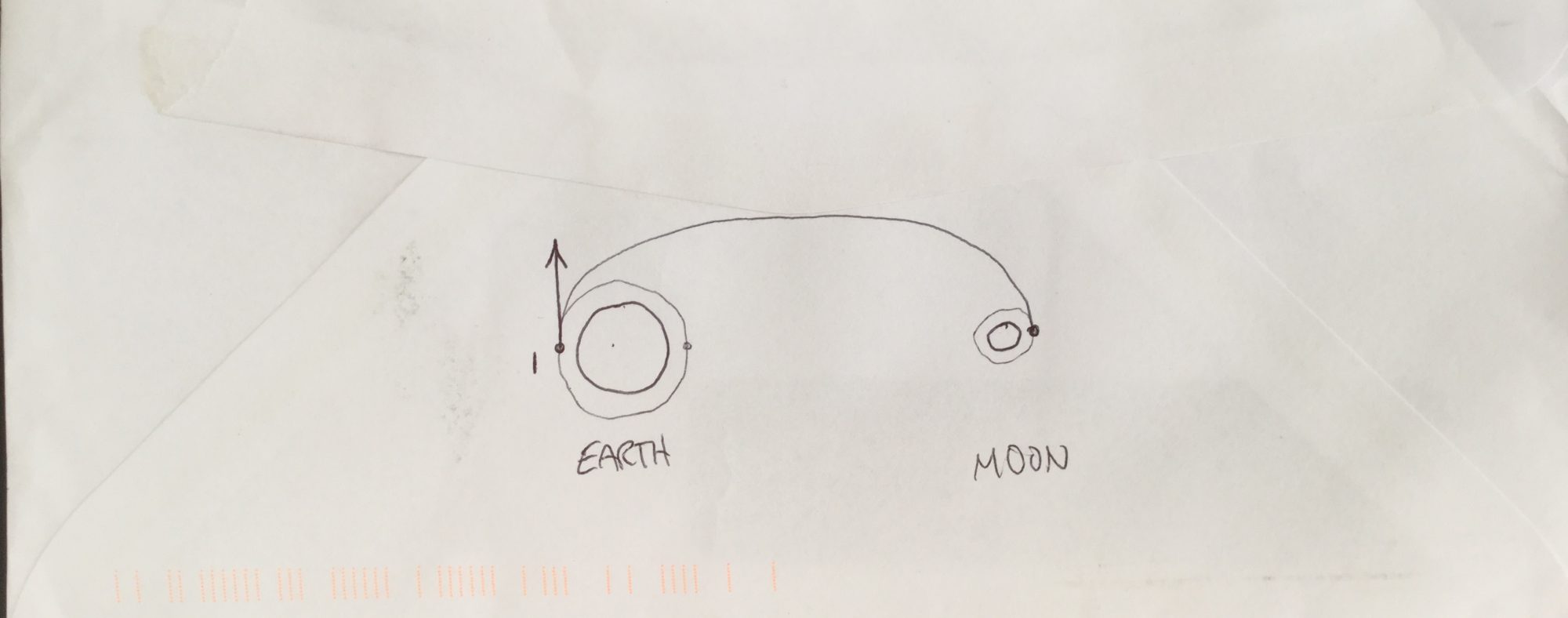
Here’s a thought experiment: draw a small circle beside a larger one and label them Moon and Earth, respectively, and ask people to draw the path a spacecraft might follow in order to travel from the Earth to the Moon. Many will draw a straight line from one circle to the other. Few will connect the two circles with an ellipse.
While you could try to aim your rocket straight at the Moon, your path would be anything but a straight line. This is because of the immense power of gravity. Inside the sphere of influence of any massive body, everything moves along clean mathematical curve shapes.
As long as you’re not actively accelerating using engines of some kind, your spacecraft is adrift in the cosmos, confined to a fixed orbit forever. In many cases, this is the final goal of the craft, to maintain a stable orbit around some stellar body.
This is achieved by executing a series of maneuvers, where we burn fuel to accelerate and change to a different orbital curve. Then we wait for gravity to pull the craft to an intersecting point on another curve. The rules are simple, but there are a lot of variables to consider when designing a launch system.
And that’s the trick – we’re never just designing the spacecraft; we’re designing the craft, as well as the plan to execute its successful deployment at some point in spacetime. We’re not just driving on paved roads to the local supermarket. Launch planning sometimes involves several maneuvers, docking with other craft for fuel, supplies, and crew transfer. Orbital alignments wait for no one.
This is the essence of Kerbalism. Thanks for watching and stay tuned!
 Kerbalism