
Vimeo: https://vimeo.com/307509709
YouTube: https://youtu.be/ZcPy605hAiM
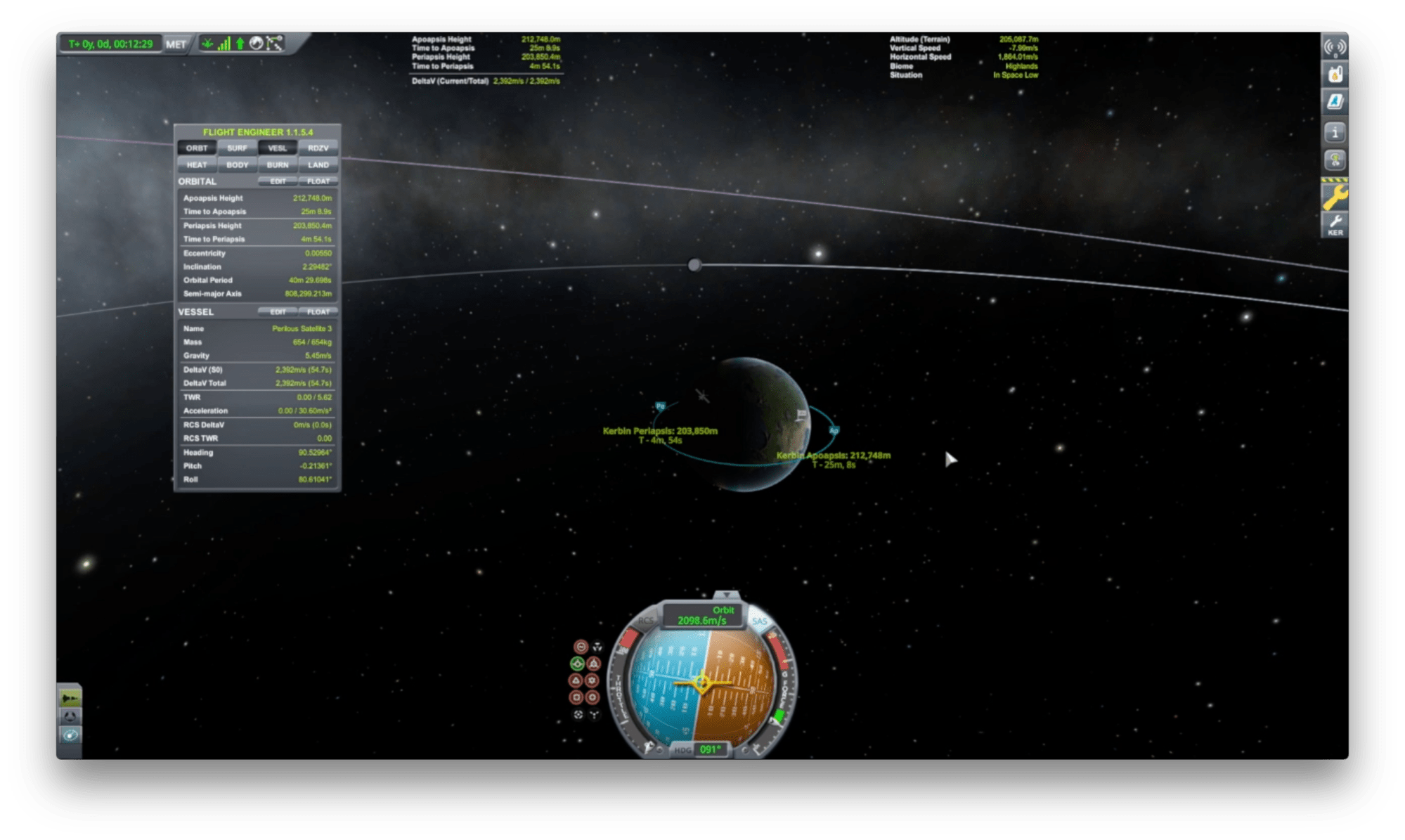
Welcome to Kerbalism! I’m your host, Aubrey Goodman. In this episode, we’ll review the basics of deploying a satellite to low orbit. Let’s get started!
Long before we think about sending people into orbit, we need to send smaller unmanned probes. These serve as opportunities to learn about the perilous environment of low orbit. As we’ll show, they also present a solution to the issue of communication within the solar system. Without relays to boost the signal back to the origin planet, probes must carry heavy radio hardware powerful enough to reach home. Heavy things cost more to send to orbit. Lowering the cost is often a matter of reducing payload mass or using fuel more efficiently. There are many things to consider, even when designing a simple satellite deployment mission.
First, let’s look at the simplest case, deploying to planetary orbit. Here, we use Kerbin as our planet. It is similar to Earth, so it works very well as a learning and planning tool.
The simplest form of an orbital launch vehicle is a single stage configuration. This means the entire vehicle is one single unit ready to fly to orbit, from takeoff through ascent to low orbit. This is both inefficient and expensive for a satellite. There’s really no reason for the heavy lift stage to remain in orbit once the satellite has reached its intended orbit.
Rather than hauling heavy engines and fuel tanks into orbit to live forever awkwardly attached to our satellite, we will consider a more popular two stage configuration. In this case, we use a solid rocket first stage and a liquid second stage for orbital stabilization and precision maneuvering.
Using a solid rocket first stage has some side effects. The most important is they burn until the fuel is gone. There is no in-flight throttle control. Throttle can be achieved by narrowing the nozzle geometry, but this is a design-time decision and significantly impacts the construction cost.
Using a liquid first stage, we would be able to cut throttle on the ascent, and throttle back up at the peak of ascent to circularize the orbit for payload deployment. Then, if we’ve done well, we can burn retrograde to return the first stage back to the surface.
 Kerbalism